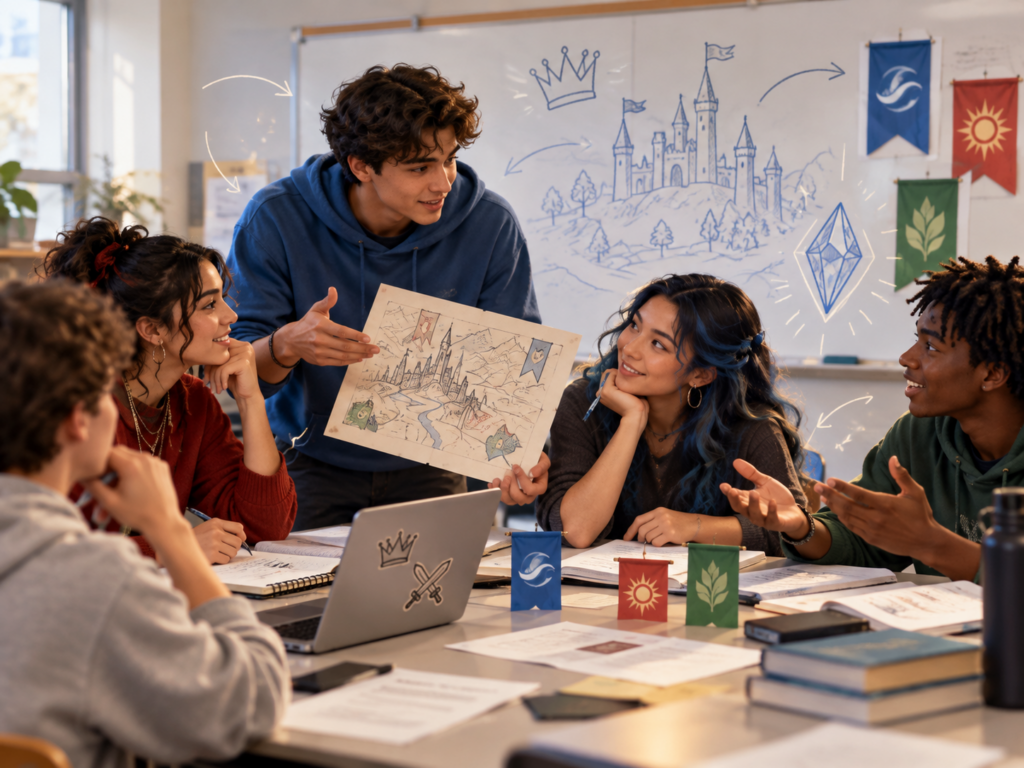
Democracy Lab: The Council of Difftown
Game Rules and Delivery Guide
Sustaining Grassroots Empowerment Project (SGE)
| Age | 16+ |
| Recommended group size | 15–18 participants |
| Political parties | 3 parties, 3 members in each |
| Voters | 6–9 citizens of Difftown |
| Duration | Approximately 90–120 minutes |
1. Purpose of the game
The Council of Difftown is a team-based role-play game for participants aged 16+. Its purpose is to show, through a fictional fantasy world, how democratic processes work in Wales: how political groups are formed, how they develop ideas and promises, how election campaigns work, how voters compare different choices, and why democratic power depends on the trust of the people.
The game is a simplified learning experience rather than an exact simulation of the Welsh electoral system. At the end of the session, the SGE team connects the events of Difftown with real democratic processes in Wales.
2. Before the game
Approximately one week before the session, every registered participant receives the World of Difftown Pack.
The pack contains:
- a short history of Difftown;
- a simple map of the city;
- descriptions of the main districts and groups of residents;
- the key issues currently facing the city;
- an explanation that Difftown is preparing for its first democratic election;
- a short glossary of the main terms used during the game.
Participants do not need to memorise the material. The pack gives them enough background to recognise the world, understand the situation and enter the game immediately when the session begins.
3. The story
Difftown is a free city that is about to choose its government democratically for the first time. The old Council no longer appoints the people who rule the city. The decision now belongs to its citizens.
Three new political parties enter the election. Each party wants to win the greatest treasure in Difftown:
THE TRUST OF THE PEOPLE
The Trust of the People represents victory in the election and the right to lead. It cannot be taken by force. A party can win it only by persuading the citizens of Difftown to vote for them.
4. Participants and roles
The recommended group size is 15–18 participants. Nine participants become politicians, divided into three parties of three. The remaining 6–9 participants become citizens and voters of Difftown. SGE facilitators are not included in the participant count.
Political parties
Each party has three members. They choose their own responsibilities. Typical roles are:
- Leader – represents the party during the main debate and gives the final election speech;
- Campaigner – speaks to citizens, listens to their concerns and tries to win support;
- Strategist / Spokesperson – helps shape the party’s message, prepares arguments and answers questions.
The titles can be changed, but all three members must take an active part in the campaign.
Citizens and voters
Every voter receives a character card. The characters represent different people and interests within Difftown.
Examples include:
- a student from the Academy;
- a young port worker;
- a small shop owner;
- a resident of a new neighbourhood;
- a young musician;
- an assistant healer;
- a forest keeper;
- a young craft worker;
- a person who has recently moved to Difftown.
Each card explains who the person is, what matters to them, what problem they are facing and one or two questions they may ask the parties. A voter is not required to choose a party only because of the issue on their card. At the end, they vote for the party that has convinced them most.
5. Creating the parties
The three teams receive approximately 15 minutes to create their political parties.
Each party creates:
- a name;
- a symbol or simple visual identity;
- a short slogan;
- three main principles or promises;
- a clear idea of what kind of future it wants for Difftown;
- a short election speech.
Real political party names, logos and symbols are not used.
6. What the SGE team provides
The SGE team brings the complete game pack. Participants do not need to prepare costumes, campaign materials or props in advance.
Costume and character elements
Participants remain in their normal everyday clothes. SGE provides small optional accessories that can be used to strengthen a party identity or character.
- coloured scarves and ribbons;
- badges and brooches;
- small capes or fabric elements;
- decorative chains;
- simple fantasy-style accessories.
Using costume elements is optional. With a creative approach, they can help a team make its campaign more memorable without turning the session into a theatrical performance.
Materials for party identity
SGE provides:
- coloured paper and card;
- markers and pens;
- stickers;
- symbol templates;
- blank cards and signs;
- ribbons;
- materials for small posters;
- blank party-name boards;
- materials for simple badges or emblems.
Teams can combine these materials freely. Creativity is encouraged, but artistic ability does not affect the election result.
Game props
The SGE game pack also includes:
- the map of Difftown;
- citizen character cards;
- challenge cards;
- ballot papers;
- pens;
- a ballot box;
- party signs;
- a timer;
- debate materials;
- the symbolic treasure The Trust of the People;
- £20 vouchers for the three members of the winning party.
7. The campaign begins
Once the parties are ready, the election campaign begins. For approximately 10–15 minutes, politicians and citizens move around the room and speak to one another.
Politicians can:
- introduce themselves to voters;
- explain their ideas and promises;
- ask citizens what matters to them;
- respond to concerns;
- try to persuade citizens to support their party.
Citizens may ask any reasonable question connected to the game. This stage demonstrates that a political programme is not enough on its own: parties also need to listen, explain and persuade.
8. Challenge Cards
During the campaign, the SGE Game Master pauses the action several times and introduces a Challenge Card. These events force the parties to respond quickly and show voters how they deal with pressure.
| The Voice of Young Difftown | Young residents say politicians never listen to them. Each party has 60 seconds to explain why young people should trust them. |
| The Forgotten District | Residents of one district say none of the parties has spoken about their problems. What does your party offer them? |
| Breaking News | An unexpected event occurs shortly before the election. Each party must quickly state its position. |
| The Difficult Question | A journalist asks the party leader a challenging question. The leader has 30 seconds to respond. |
| A Rival Challenge | Another party may ask one critical question about a campaign promise. The answer must be given immediately. |
9. The Great Difftown Debate
After the campaign, the three party leaders take part in the final debate in front of the voters.
Each party receives:
- approximately one minute for its main election message;
- one question from The Difftown Chronicle journalist;
- one question from a citizen of Difftown;
- the opportunity to ask one question of another party;
- a short final statement answering: Why should Difftown trust us?
The main rule of the debate is simple: ideas and proposals may be challenged; people may not be personally attacked.
10. The election
Only participants playing citizens of Difftown vote. Members of the political parties do not vote for themselves or for rival parties.
Each voter receives one ballot paper and chooses one of the three parties. Voting is secret. The completed ballot is placed in the ballot box.
When voting closes, the Election Officer opens the ballot box and counts the votes publicly.
11. The winner and the prize
The party receiving the highest number of votes wins the election and receives the symbolic treasure:
THE TRUST OF THE PEOPLE
The three members of the winning party also receive recognition for their active participation: each receives a £20 voucher. The total voucher prize for one game is £60.
12. If the result is tied
If two parties receive the same highest number of votes, a second round is held between those two parties.
Each party receives 60 seconds for one final appeal to the voters: Why should Difftown trust you? The citizens then vote again between the two parties.
13. Roles performed by the SGE team
The game is normally delivered by two or three SGE facilitators. One person may perform more than one role when required.
Game Master / Keeper of Difftown
- welcomes participants into the world of Difftown;
- explains the rules;
- starts and ends each stage;
- keeps the session moving and monitors time;
- introduces new events and Challenge Cards;
- maintains the pace, atmosphere and fairness of the game.
Journalist – The Difftown Chronicle
- questions the political parties;
- announces Breaking News;
- supports or moderates the final debate;
- asks leaders to explain vague or unclear promises;
- adds humour, pressure and unpredictability to the campaign.
Election Officer
- explains the voting procedure;
- issues ballot papers;
- protects the secrecy of the vote;
- controls the ballot box;
- counts the votes publicly;
- announces the official result.
The Election Officer remains neutral throughout the game. If only two SGE facilitators are present, the Journalist and Election Officer roles can be combined.
14. Rules of conduct
To keep the game safe, fair and politically neutral:
- real political parties are not used;
- real party logos and campaign materials are not copied;
- real politicians are not impersonated;
- participants do not campaign for real parties or candidates;
- personal insults, discriminatory language and aggressive behaviour are not allowed;
- votes cannot be bought, traded or demanded;
- no participant may interfere with another person’s free choice;
- the announced result cannot be altered after the count.
15. Final discussion: from Difftown back to Wales
After the result is announced, the fantasy story ends and the SGE team leads a short discussion of approximately 10 minutes.
Participants are asked questions such as:
- What made you trust one party more than another?
- What mattered most: promises, the leader, conversations with voters or answers during the debate?
- Did you change your mind during the game?
- Was it difficult for politicians to understand what different people wanted?
- Can one party please every voter?
- Why is a secret ballot important?
- Why do parties need to explain and defend their promises?
The SGE team then connects the game to the democratic process in Wales. Participants have already experienced the main stages themselves:
party → manifesto → campaign → voters → debate → secret ballot → count → election result